Wednesday, February 19, 2014

WHAT IS HIDDEN IN THE AMNESTY BILL?

WATCH: Ted Cruz exposed $5000 penalty for hiring US workers hidden in amnesty bill


TITANIC REPUBLICAN SHIFT IN KEY SENATE RACE

Stockman, the underdog, passes the incumbent, John Cornyn, in the polls. Read the play by play...

Copied from the folliowing link:


Sen. John Cornyn, R-Texas, and Rep. Steve Stockman, R-Texas

WASHINGTON – It is a monumental shift in major race that could be sending shock waves through the GOP establishment.

Underfunded and targeted by GOP strategist Karl Rove, Rep. Steve Stockman, R-Texas, has defied the odds in his long-shot bid to topple the second-most powerful Republican in the U.S. Senate, and he’s on the verge of forcing a crucial runoff with incumbent Sen. Jon Cornyn, R-Texas, in the Texas GOP primary.

According to the results of a stunning new poll, Cornyn has fallen from 50 percent to 43 percent.

That means Cornyn would have to gain eight points in the next two weeks to break the 50 percent threshold to avoid a runoff, but he seems to be losing ground, fast.

A runoff is critical because it can change the entire direction of a race.

That’s why forcing a runoff is the centerpiece of Stockman’s strategy, the same strategy that sent Sen. Ted Cruz, R-Texas, to the Senate in 2012.

Sen. Ted Cruz, R-Texas

The goal is to force a runoff to buy time needed to rally the grassroots, raise funds and obtain key endorsements.

Cruz entered the race in 2012 as a little-known and under-funded outsider taking on the GOP establishment candidate.

Cruz began with a double-digit deficit in the polls, but after getting his opponent under 50 percent and forcing a runoff election, he garnered key endorsements from such GOP kingmakers as Sarah Palin and Jim DeMint. Cruz then went on to beat Lt. Gov. David Dewhurst by 14 points in the runoff and then beat the Democrat by 15 points in November.

But Stockman hasn’t just put Cornyn in danger of a runoff. In a dramatic turnaround, the challenger has also put himself within striking distance of the incumbent, and he’s closing – fast.

When Stockman unexpectedly entered the race at the last minute in December, the initial poll had Cornyn at 50 percent and Stockman at 6 percent, a difference of 44 points.

With the latest poll showing Stockman has jumped to 28 percent and Cornyn has fallen to 43 percent, the difference is now just 15 points.

That means Stockman has made up an incredible 29 points since entering the race.

Gravis Marketing conducted the poll, and company President Doug Kaplan observed, “These are dangerous numbers for Cornyn, because they show that despite his power in the Senate and his familiarity with the voters, he has not yet made the sale.”

Cornyn, the minority whip in the Senate, wasintroduced at a fundraiser in Longview, Texas, on Sunday by Rove.

http://images1.dailykos.com/i/user/5179/karl_rove.jpg

Karl Rove

Stockman told WND, “Rove got on stage and said, ‘John Cornyn is the second-most conservative senator,’ which begs the question, who is first? Who is the most conservative senator? Is it Mike Lee? Is it Rand Paul? Is it Ted Cruz?”

Answering his own question, the congressman continued, “No, in 2010 the National Journal ruled that John McCain was the most conservative member of the Senate. So it puts my opponent in an awkward position, because it means John Cornyn is more liberal than John McCain.”

Stockman pointed out that Rove and Cornyn do not mention who did the ranking. Indeed, it was theNational Journal that declared McCain the Senate’s most-conservative member in 2010.

The congressman also pointed out that the conservative Heritage Foundation ranked him and Cruz as the most conservative Texans.

As for the poll showing him dramatically gaining ground on Cornyn, Stockman told WND, “I am very encouraged. I am hopeful that it’s true. If it is true, it will rock the establishment and defy the declarations that we are running a horrible campaign and don’t know what we’re doing.”

Stockman also zeroed in on crucial factor revealed by the poll. While there are now only 15 points separating the two candidates, 29 percent of Texans are still undecided, giving the congressman ample opportunity to catch the senator.

The challenger told WND his “gut” tells him Cornyn is not releasing the results of his own polls because “he is fearful that a lot of the undecideds will not break his way.”
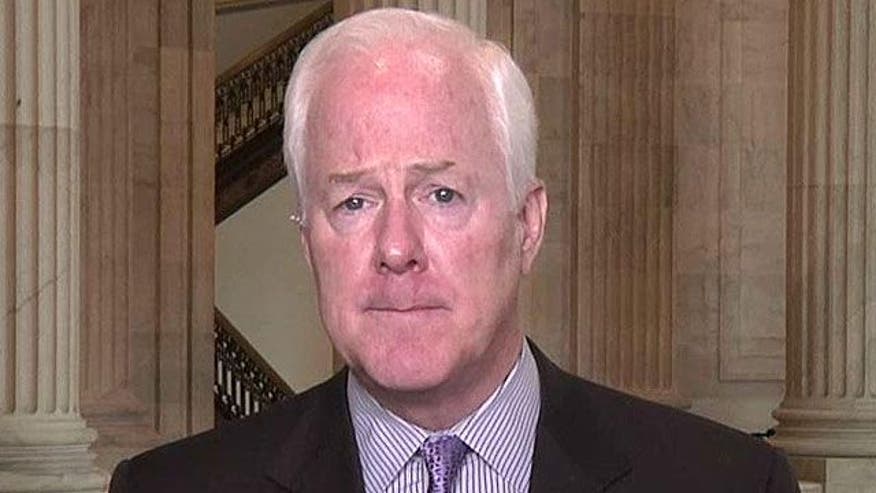
http://a57.foxnews.com/global.fncstatic.com/static/managed/img/fn2/video/876/493/hn_cornyn2a_061212.jpg?ve=1&tl=1

Sen. John Cornyn, R-Texas

“We don’t tell everybody our campaign strategy when asked about it, but we have been very aggressive in numerous ways, and we have apparently made inroads. And we’ll continue what we’re doing,” said a soft-spoken but seemingly confident Stockman.

Another potentially key factor that could help Stockman is that the Gravis poll was done from Feb. 10 to 12. That was just before Cornyn joined Sen. Minority Leader Mitch McConnell, R-Ky., in casting the key votes that persuaded just enough fellow Republicans to join Democrats in lifting the debt ceiling.

Stockman mentioned that could cost Cornyn even more percentage points, because the vote was sure to have upset conservatives.

Even before the latest poll was released, a buoyant Stockman told WND, “Cornyn is on the ropes. His campaign is in full panic mode. He can’t even top 50 percent after 22 years and tens of millions spent.”

Cornyn has almost $7 million in campaign funds in the bank compared to Stockman’s $47,000, but Stockman has gained key name recognition, and has made a name for himself in a short time during his second stint in Congress (he previously served from 1995 to 1997), as one of the most reliably conservative voices in the House of Representatives.

Stockman has garnered a reputation for stinging one-liners with such tweets as, “Liberals love diversity. That’s why they punish anyone who doesn’t think, act, eat, drink, drive and speak exactly like them.”

Scathing remarks like that are why Stockman has become the darling of so many conservatives and the bogeyman to such liberal outfits as MSNBC.

The congressman has made numerous fans and foes with such headline-grabbing maneuvers as bringing WND columnist Ted Nugent as his guest to last year’s State of the Union address, and calling for the House to begin impeachment proceedings against President Obama after walking out during this year’s address.

http://blogs.dallasobserver.com/unfairpark/SteveStockmanTedNugent-600x399.jpg

Ted Nugent and Rep. Steve Stockman, R-Texas

Now he is taking the biggest gamble of his political career, risking his safe seat as a member of the House in a long-shot bid to oust Cornyn.

The congressman found it interesting that Cornyn is not releasing the result of his own polls, saying, “If they were good, trust me, they’d be released.”

Another indication the poll numbers are not good for the incumbent: The congressman says the senator’s people are stepping up the attacks, and the Cornyn campaign itself is now doing anti-Stockman attack ads, “So they must be scared of something.”

Stockman said his opponent is being so aggressive because the numbers for Cornyn are not as strong as he would hope, and there are still a lot of undecided voters. “As a 12-year incumbent you’d think he’d have a stronger base.”

The congressman said all of his victories have been David versus Goliath races, noting that he beat the chairman of the House Judiciary Committee, Rep. Jack Brooks, D-Texas, in 1994 even though the incumbent outspent him by 12 to one.

How does he do it?

The man who likes to say, “I was tea party before there was a tea party,” says the trick is getting his conservative message to the voters.

“In 2012, I was such an underdog the Houston Chronicle proclaimed I had no chance of winning. They did this horrible piece on me, then said, ‘But don’t worry! He has no chance of winning, because he has no campaign ads, no consultants’ and so on,” Stockman cheerfully recounted.

He claimed that despite facing 12 candidates, including a multimillionaire, and running in a gerrymandered district that had been carved-out for the third-highest ranking Texas official, who the papers declared had the race all but sewn-up, “We were victorious because we ran on a conservative platform that spoke to the grassroots.”

Why is this such an important election?

“Because John Cornyn is the second-highest ranking official in the Senate. He sets agendas. That’s why I gave up my seat. He’s so critical to the direction this nation is going, and to have someone who is committed to being less confrontational with Obama and try to be more appealing to Obama, as he advised, I think is a mistake,” the congressman opined.

Stockman said the GOP actually lost seats when Cornyn was chairman of the National Republican Senatorial Committee because he doesn’t advocate a conservative agenda. The congressman said the senator only sounds like a conservative when he runs for re-election.

“Even though his ads say he is a conservative, (Texas Democratic gubernatorial candidate) Wendy Davis sounds like a conservative. Obama sounded like a conservative when he was running, if you actually listened to the rhetoric. But we have to look at his voting record and his positions. And it is abundantly clear that they are different than the mainstream conservative values.”

Illustrating his point, Stockman said “A vote for Cornyn is a vote for Obamacare.”

http://info.whatisbluesky.com/Portals/148740/images/obamacare-logo_full.png

The congressman said Cornyn has supported Obamacare numerous times in the false notion that it’s going to help the Republican Party, adding, “That’s going to absolutely destroy our nation.”

That’s why, he said, it is so important to beat the man who now serves as minority whip in the Senate.

His voice rising to demonstrate his conviction, Stockman declared, “I gave up my safe U.S. House seat to run against John Cornyn for U.S. Senate because I don’t want to see the Obamacare repeal movement defeated. I am willing to risk everything to see Obamacare repealed.”

The congressman maintained it is one thing to face a Democrat as a clearly defined opponent, but quite another when you have a Republican who consistently works against other Republicans, saying that Cornyn worked against Sen. Marco Rubio in Florida, Senate candidate Joe Miller in Alaska and even against his fellow Texas senator, Cruz.

In fact, when Stockman broke the news to WND in December that he would challenge Cornyn, the congressman cited as his top reason how the incumbent GOP senator “undermined Sen. Ted Cruz’s fight to stop Obamacare.”

“It’s better to have someone who’s knows what he stands for as opposed to a Republican who acts more like a Democrat,” Stockman now adds.

On another hot-button issue, Stockman pointed out that Cornyn had claimed that Republicans could not win in 2016 without “resolving” the immigration issue, which conservatives took to mean granting amnesty to illegal immigrants.

“He’s come out time and time again for it. He did a bill promoting it with Lindsey Graham, and he’s now trying to distance himself from it. The people sending out these attack ads are primarily pro-amnesty people.”

And, he added, they didn’t like that he killed the amnesty bill (Sen. Majority Leader) Harry Reid (D-Nev.) had sent to the House.

“We did what’s called a ‘blue-slip.’ We declared it a tax, which it is because the Supreme Court ruled the fees in the health care bill are taxes. The Senate cannot create or generate any revenue. The Constitution gives that power strictly to the House. The House creates what’s called a blue slip, in that event, and I did that to both the immigration and the gun bills.”

Stockman seemed unperturbed, even though his campaign isn’t just uphill, it has turned downright nasty as he comes under a withering attack from establishment Republicans.

A super Political Action Committee, or PAC, supporting Cornyn made such stunning claims about Stockman that he filed a lawsuit claiming “numerous false statements” including “some of the most outrageous, malicious defamation ever recorded in Harris County (Texas).”

The congressman’s office said the PAC lists Karl Rove’s Warrenton, Va., address in TV station records for its ad purchases.

Stockman believes the lawsuit has “put a stop to some of the (negative) attitude and false claims made by the local press.”

He said he is hoping to see documents the PAC claims to have, because “Cornyn’s people are saying they’re sticking by their story. But, we’d like to see what kind of proof they have because some of these false claims are just outrageous.”

Stockman said the PAC has not stopped running ads with false claims and “It’s ironic because John Cornyn himself has used federal funds in his campaign, which is a huge no-no.”

Stockman said Cornyn has had 121 Federal Election Commission, or FEC, corrections and he has also had to back and report outside income.

“It’s kind of ironic that he’s attacking me on ethics when he’s got major problems.”

WND broke the news that Stockman plans to file an ethics complaint in the Senate against Cornyn, citing 24 alleged campaign violations.

A Stockman spokesman told WND a formal Request For Investigation was filed with the Senate Ethics Committee Monday. He said Cornyn used his Senate office to promote his re-election campaign.

Stockman closed by mentioning that any Texan, or any American, who wants to help his campaign can inform themselves on the issues, look at his website to see positions, contribute and even help campaign.

“We’ve been against the odds before and have prevailed in most cases. Not always, but we’re pretty good campaigners.”

Follow Garth Kant on Twitter @DCgarth.


Tuesday, February 18, 2014

We Are Not SUBJECTS:

We Are Not SUBJECTS (and Other Observations About Obamacare)

Copied from link below

The unveiling of the dictatorial debacle that is Obamacare absolutely flabbergasts me. It is stunning on so many levels, but the most shocking aspect of it for me is watching millions of free Americans stand idly by while this man, his minions in Congress and his cheerleaders in the press systematically dismantle our Constitution, steal our money, and crush our freedoms.

The President, Nancy Pelosi and Harry Reid (with no small help from Justice John Roberts) take away our health care, and we allow it. They take away our insurance, and we allow it. They take away our doctors, and we allow it. They charge us thousands of dollars more a year, and we allow it. They make legal products illegal, and we allow it. They cripple our businesses, and we allow it. They announce by fiat that we must ignore our most deeply held beliefs – and we allow it.

Where is your spine, America?

Yes, I know people are complaining. I read the news on the internet. I read blogs. I have a Twitter feed. So what? People in the Soviet Union complained. People in Cuba complain. People in China complain (quietly). Complaining isn’t the same thing as doing anything about it. In fact, much of the complaining that we hear sounds like resignation: Wow. This sucks. Oh well, this is the way things are. Too bad.

Perhaps you need reminding of a few important facts. Here goes:

1. The President is not a king 
Barack Obama does not behave like a President, an elected official, someone who realizes that he works for us. He behaves like a king, a dictator – someone who believes that his own pronouncements have the force of law, and who thinks he can dispense with the law’s enforcement when he deigns to do so. And those of us who object? How dare we? Racists!

And while he moves steadily “forward” with his plans to “fundamentally transform” the greatest country in human history, he distracts people with cheap, meaningless trivialities, like “free birth control pills”! (In fact, let’s face it: this administration’s odd obsession with sex in general - Birth control! Abortion! Sterilization! Gay guys who play basketball! -- is just plain weird. Since when did the leader of the free world care so much about how people have sex, who they have it with, and what meds they use when they have it? Does he have nothing more important to concern himself with?)

2. It isn’t just a failed software program; it is a failed philosophy
People are marveling that Healthcare.gov was such a spectacular failure. Well, if one is only interested in it as a product launch, I’ve explained some of the reasons for that here. But the larger point is that it isn’t a software failure, or even a product failure; it is a philosophy failure.

I have said this before: Obama is not a centrist; he is a central planner. And this – all of it: the disastrous computer program, the hundreds of millions of dollars wasted, the lies, the manipulation of public opinion, the theft of the public’s money and property, and freedom (read insurance, and premiums, and doctors) -- IS what central planning looks like.

The central premise of central planning is that a handful of wunderkinds with your best interests at heart (yeah, right) know better than you what’s good for you. The failure of such a premise and the misery it causes have been clear from the dawn of humanity. Kings and congressmen, dictators and Dear Leaders, potentates, princes and presidents can all fall prey to the same imperial impulses: “we know what is good for ‘the people.’

And they are always wrong.

There is a reason that the only times communism has really been tried have been after wars, revolutions, or coups d’état. You have to have complete chaos for people to be willing to accept the garbage that centralized planning produces. Take the Soviet Union, for example. After two wars, famine, and the collapse of the Romanov dynasty, why wouldn’t people wait in line for hours to buy size 10 shoes? Or settle for the gray matter that passed for meat in the grocery stores?

But communism’s watered-down cousin, socialism, isn’t much better. Ask the Venezuelans who cannot get toilet paper. Toilet paper. ¡Viva la Revolución!

Contrary to what so many who believe in a “living Constitution” say, the Founding Fathers absolutely understood this. That is why the Constitution was set up to limit government power. (Memo to the President: the drafters of the Constitution deliberately didn’t say “what government had to do on your behalf.”) They understood that that was the path to folly, fear, and famine.)

3. Obama is deceitful
Just as the collapse of the computer program should not surprise anyone, neither should we be shocked that the President lied about his healthcare plan. Have any of you been paying attention over the past few years? Obama has made no secret of his motivations or his methods. The philosophies which inspire him espouse deceit and other vicious tactics. (Don’t take my word for it: read Saul Alinsky.) Obama infamously told reporter Richard Wolffe, “You know, I actually believe my own bullshit.” He has refused to be forthcoming about his past (where are his academic records?). His own pastor, Rev. Jeremiah Wright, told author Ed Klein, that Obama said to him, “You know what your problem is? You have to tell the truth.”

Did Obama lie when he said dozens of times, “If you like you plan, you can keep it”? Of course he did.  That’s what he does.

4. The media is responsible
And had the media been doing their jobs, we would have known a lot of this much, much earlier.

The press is charged with the sacred responsibility of protecting the people from the excesses of government. Our press has been complicit, incompetent, or corrupt. Had they vetted this man in 2008, as they would have a Republican candidate, we would have known far more about him than we do, even now. Had they pressed for more details about Obamacare, Congress’ feet would have been held to the fire. Had they done their jobs about Eric Holder, Fast and Furious, Benghazi, the IRS scandal, NSA spying - or any of the other myriad betrayals of the public trust that this administration has committed, Obama would likely have lost his 2012 reelection campaign. (A fact which even the Washington Post has tacitly acknowledged. Well done, fellas! Happy now?)

Instead, they turned a blind eye, even when they knew he was lying, abusing power, disregarding the limits of the Constitution. It was only when he began to spy on them, and when the lies were so blatant that the lowest of low-information voters could figure it out that they realized they had to report on it. (Even in the face of blatant, deliberate and repeated lies, the New York Times has the audacity to tell us that the President “misspoke.”) They have betrayed us, abandoned us, and deceived us.

5. Ted Cruz was right. So was Sarah Palin. 
The computer program is a disaster. The insurance exchanges are a disaster. What’s left? The healthcare system itself. And this, of necessity, will be a disaster, too.

Millions of people have lost their individual insurance plans. In 2015, millions more will lose their employer-provided coverage (a fact which the Obama administration also knew, and admitted elsewhere).

The exorbitant additional costs that Obamacare has foisted on unsuspecting Americans are all part of a plan of wealth confiscation and redistribution. That is bad enough. But it will not end there.

When the numbers of people into the system and the corresponding demand for care vastly exceed the cost projections (and they will, make no mistake), then the rationing will start. Not only choice at that point, but quality and care itself will go down the tubes. And then will come the decisions made by the Independent Payment Advisory Board about what care will be covered (read “paid for”) and what will not.

That’s just a death panel, put politely. In fact, progressives are already greasing the wheels for acceptance of that miserable reality as well. They’re spreading the lie that it will be about the ability of the dying to refuse unwanted or unhelpful care. Don’t fall for that one, either. It will be about the deaths that inevitably result from decisions made by people other than the patients, their families, and their physicians. (Perhaps it’s helpful to think of their assurances this way: “If you like your end-of-life care, you can keep your end-of-life-care.”)

6. We are not SUBJECTS (or, Nice Try, the Tea Party Isn’t Going Away) We have tolerated these incursions into our lives and livelihoods too long already. There is no end to the insatiable demand “progressives” have to remake us in their image. Today it is our insurance, our businesses, our doctors, our health care. Tomorrow some new crusade will be announced that enables them to take over other aspects of our formerly free lives.

I will say it again: WE ARE NOT SUBJECTS. Not only is the Tea Party right on the fiscal issues, but it appears that they are more relevant than ever. We fought a war once to prove we did not want to be the subjects of a king, and the Boston Tea Party was just a taste of the larger conflict to come. If some people missed that lesson in history class, we can give them a refresher.

The 2014 elections are a good place to start. Call your representative, your senator, your candidate and tell them: “We are not subjects. You work for us. And if the word “REPEAL” isn’t front and center in your campaign, we won’t vote for you. Period.”


Laura Hollis is an attorney and teaches entrepreneurship and business law at theUniversity of Notre Dame. She resides in Indiana with her husband and two children.


The Electoral College: Are you Smarter Than A Fifth Grader

Congress for Kids: [Elections]: The Electoral College
The Electoral College

Did you know that voters in the United States don't vote for the president? People actually vote for a group of electors when they go to the polls on Election Day. These electors have pledged to support a              party's nominee for president. In many states the ballot lists only the names of the nominees and not the names of the electors, so many people believe they are voting for the president.

In 1787, the delegates to the Constitutional Convention decided on this system of indirect election of the president. Long debates took place about how to make sure the best candidate would be chosen as president. Some delegates supported a direct election by citizens. Others favored              having Congress choose the president. Still others thought that state legislatures should make the choice.

The delegates finally agreed on a compromise. Electors chosen by each state would elect the president. Ordinary citizens in each state would have a say this way, but the final decision would be made by people who were better informed about the candidates and the issues.

The Electoral College, this system of presidential electors, is still in effect today, although some adjustments have been made over the years. The electors voted for two candidates at first. The one with the highest number of votes became president. The one with the second-highest number became vice president. In 1796, political foes were chosen for the two posts -- Federalist John Adams for president and Democratic-Republican Thomas Jefferson for vice president.

There was a tie between Thomas Jefferson and Aaron Burr in the next election. The House of Representatives had to decide who would be president. The fact that the system needed to be adjusted was clear. The 12th Amendment to the Constitution was passed in 1804. Candidates are now nominated to run only for president or only for vice president. Electors vote for president and vice president separately.

How the states elect electors has changed, too. Some states held direct popular elections for the electors in the beginning. The state legislatures made the choice in other states. All the states gradually adopted direct popular elections for electors.

There were no political parties when the Constitution was written. They soon developed, and the party organizations in each state began proposing a slate, or list, of electors who were pledged to vote for their party's nominee. Voters no longer choose individual electors. Voters choose between party slates.

Political parties want winner-take-all elections for electors. This means that the slate that receives the most popular votes wins all the state's electoral votes. All the states except Maine use this winner-take-all system today.

 Show What You Know

WALL STREET, MAIN STREET AND BRIDGES TO NOWHERE

Quotes from the article below by Huffington Post writer Kevin Roose, could apply to any group of socially or culturally connected people caught up in "the game" of life. This is not a new scenario. It is the "reality" of what any culture produces without a moral standard: exclusivity. Young versus old, educated versus uneducated, blue collar and white collar, black-white-Asian-Hispanic-Jewish-Christian-Catholic-male-female... The list is endless. There is nothing new here. It is only uncovered, naked, raw, blatant, exposed, real. 

Kevin describes what he witnessed in the three quotes below. But far from describing one isolated privileged group of wealthy Wall Street moguls, Keven describes the basic plight of mankind, regardless of rank or station in life. 

"...people who have completely divorced themselves from reality."

Humanity IS a fear based "organization". It is what drives mankind to react rather than act, to hide rather than be courageous  to blend in rather than stand out. From Wall Street to Main Street, fear is a bridge to nowhere. It divides and sets barriers between us. It shields us from having to deal with reality. It's then"what you don't know won't hurt you syndrome. 

"...a fear-based organization. Here were executives who had strong ideas about politics, society, and the work of their colleagues, but who would never have the courage to voice those opinions in a public setting." 

Roosevelt asks himself, "What changed"?  What happened to these men and as they developed from youth into their current state"?

"...members had surely been first-year bankers once. And in the 20, 30, or 40 years since, something fundamental about them had changed. Their pursuit of money and power had removed them from the larger world to the sad extent that, now, in the primes of their careers, the only people with whom they could be truly themselves were a handful of other prominent financiers." 

With all of this in mind, I challenge Roose's admonition regarding the apparent cavalier attitude toward the suffering caused by the inexcusable irresponsibility of Wall Stree through the years and beg the question: Were these well dressed, well fed, brazen action those of calloused and thoughtless individuals or is this a classic example of "laughing to keep from crying" or even better still, laughter to mask their inner shame?

The Huffimgton Post article, in its entirety, was copied from the link below:

1% Jokes and Plutocrats In Drag: What I Saw When I Crashed a Wall Street Secret Society

Recently, our nation’s financial chieftains have been feeling a little unloved. Venture capitalists are comparing the persecution of the rich to the plight of Jews at Kristallnacht, Wall Street titans are saying that they’re sick of being beaten up, and this week, a billionaire investor, Wilbur Ross, proclaimed that “the 1 percent is being picked on for political reasons.”

Ross's statement seemed particularly odd, because two years ago, I met Ross at an event that might single-handedly explain why the rest of the country still hates financial tycoons – the annual black-tie induction ceremony of a secret Wall Street fraternity called Kappa Beta Phi.

“Good evening, Exalted High Council, former Grand Swipes, Grand Swipes-in-waiting, fellow Wall Street Kappas, Kappas from the Spring Street and Montgomery Street chapters, and worthless neophytes!”

It was January 2012, and Ross, wearing a tuxedo and purple velvet moccasins embroidered with the fraternity’s Greek letters, was standing at the dais of the St. Regis Hotel ballroom, welcoming a crowd of two hundred wealthy and famous Wall Street figures to the Kappa Beta Phi dinner. Ross, the leader (or “Grand Swipe”) of the fraternity, was preparing to invite 21 new members — “neophytes,” as the group called them — to join its exclusive ranks.

Looking up at him from an elegant dinner of rack of lamb and foie gras were many of the most famous investors in the world, including executives from nearly every too-big-to-fail bank, private equity megafirm, and major hedge fund. AIG CEO Bob Benmosche was there, as were Wall Street superlawyer Marty Lipton and Alan “Ace” Greenberg, the former chairman of Bear Stearns. And those were just the returning members. Among the neophytes were hedge fund billionaire and major Obama donor Marc Lasry and Joe Reece, a high-ranking dealmaker at Credit Suisse. [To see the full Kappa Beta Phi member list, click here.] All told, enough wealth and power was concentrated in the St. Regis that night that if you had dropped a bomb on the roof, global finance as we know it might have ceased to exist.

During his introductory remarks, Ross spoke for several minutes about the legend of Kappa Beta Phi – how it had been started in 1929 by “four C+ William and Mary students”; how its crest, depicting a “macho right hand in a proper Savile Row suit and a Turnbull and Asser shirtsleeve,” was superior to that of its namesake Phi Beta Kappa (Ross called Phi Beta Kappa’s ruffled-sleeve logo a “tacit confession of homosexuality”); and how the fraternity’s motto, “Dum vivamus edimus et biberimus,” was Latin for “While we live, we eat and drink.”

On cue, the financiers shouted out in a thundering bellow: “DUM VIVAMUS EDIMUS ET BIBERIMUS.”

The only person not saying the chant along with Ross was me — a journalist who had sneaked into the event, and who was hiding out at a table in the back corner in a rented tuxedo.

Several Kappas at the table next to me, presumably discussing the coming plutocracy.

I’d heard whisperings about the existence of Kappa Beta Phi, whose members included both incredibly successful financiers (New York City's Mayor Michael Bloomberg, former Goldman Sachs chairman John Whitehead, hedge-fund billionaire Paul Tudor Jones) and incredibly unsuccessful ones (Lehman Brothers CEO Dick Fuld, Bear Stearns CEO Jimmy Cayne, former New Jersey governor and MF Global flameout Jon Corzine). It was a secret fraternity, founded at the beginning of the Great Depression, that functioned as a sort of one-percenter’s Friars Club. Each year, the group’s dinner features comedy skits, musical acts in drag, and off-color jokes, and its group’s privacy mantra is “What happens at the St. Regis stays at the St. Regis.” For eight decades, it worked. No outsider in living memory had witnessed the entire proceedings firsthand.

A Kappa neophyte (left) chats up a vet.

I wanted to break the streak for several reasons. As part of my research for my book, Young Money, I’d been investigating the lives of young Wall Street bankers – the 22-year-olds toiling at the bottom of the financial sector’s food chain. I knew what made those people tick. But in my career as a financial journalist, one question that proved stubbornly elusive was what happened to Wall Streeters as they climbed the ladder to adulthood. Whenever I’d interviewed CEOs and chairmen at big Wall Street firms, they were always too guarded, too on-message and wrapped in media-relations armor to reveal anything interesting about the psychology of the ultra-wealthy. But if I could somehow see these barons in their natural environment, with their defenses down, I might be able to understand the world my young subjects were stepping into.

So when I learned when and where Kappa Beta Phi’s annual dinner was being held, I knew I needed to try to go.

Getting in was shockingly easy — a brisk walk past the sign-in desk, and I was inside cocktail hour. Immediately, I saw faces I recognized from the papers. I picked up an event program and saw that there were other boldface names on the Kappa Beta Phi membership roll — among them, then-Citigroup CEO Vikram Pandit, BlackRock CEO Larry Fink, Home Depot billionaire Ken Langone, Morgan Stanley bigwig Greg Fleming, and JPMorgan Chase vice chairman Jimmy Lee. Any way you count, this was one of the most powerful groups of business executives in the world. (Since I was a good 20 years younger than any other attendee, I suspect that anyone taking note of my presence assumed I was a waiter.)

I hadn’t counted on getting in to the Kappa Beta Phi dinner, and now that I had gotten past security, I wasn’t sure quite what to do. I wanted to avoid rousing suspicion, and I knew that talking to people would get me outed in short order. So I did the next best thing — slouched against a far wall of the room, and pretended to tap out emails on my phone.

The 2012 Kappa Beta Phi neophyte class.

After cocktail hour, the new inductees – all of whom were required to dress in leotards and gold-sequined skirts, with costume wigs – began their variety-show acts. Among the night’s lowlights:

• Paul Queally, a private-equity executive with Welsh, Carson, Anderson, & Stowe, told off-color jokes to Ted Virtue, another private-equity bigwig with MidOcean Partners. The jokes ranged from unfunny and sexist (Q: “What’s the biggest difference between Hillary Clinton and a catfish?” A: “One has whiskers and stinks, and the other is a fish”) to unfunny and homophobic (Q: “What’s the biggest difference between Barney Frank and a Fenway Frank?” A: “Barney Frank comes in different-size buns”).

• Bill Mulrow, a top executive at the Blackstone Group (who was later appointed chairman of the New York State Housing Finance Agency), and Emil Henry, a hedge fund manager with Tiger Infrastructure Partners and former assistant secretary of the Treasury, performed a bizarre two-man comedy skit. Mulrow was dressed in raggedy, tie-dye clothes to play the part of a liberal radical, and Henry was playing the part of a wealthy baron. They exchanged lines as if staging a debate between the 99 percent and the 1 percent. (“Bill, look at you! You’re pathetic, you liberal! You need a bath!” Henry shouted. “My God, you callow, insensitive Republican! Don’t you know what we need to do? We need to create jobs,” Mulrow shot back.)

• David MooreMarc Lasry, and Keith Meister — respectively, a holding company CEO, a billionaire hedge-fund manager, and an activist investor — sang a few seconds of a finance-themed parody of “YMCA” before getting the hook.

• Warren Stephens, an investment banking CEO, took the stage in a Confederate flag hat and sang a song about the financial crisis, set to the tune of “Dixie.” (“In Wall Street land we’ll take our stand, said Morgan and Goldman. But first we better get some loans, so quick, get to the Fed, man.”)

A few more acts followed, during which the veteran Kappas continued to gorge themselves on racks of lamb, throw petits fours at the stage, and laugh uproariously. Michael Novogratz, a former Army helicopter pilot with a shaved head and a stocky build whose firm, Fortress Investment Group, had made him a billionaire, was sitting next to me, drinking liberally and annotating each performance with jokes and insults.

“Can you fuckin’ believe Lasry up there?” Novogratz asked me. I nodded. He added, “He just gave me a ride in his jet a month ago.”

The neophytes – who had changed from their drag outfits into Mormon missionary costumes — broke into their musical finale: a parody version of “I Believe,” the hit ballad from The Book of Mormon, with customized lyrics like “I believe that God has a plan for all of us. I believe my plan involves a seven-figure bonus.” Amused, I pulled out my phone, and began recording the proceedings on video. Wrong move.

The grand finale, a parody of "I Believe" from The Book of Mormon

“Who the hell are you?” Novogratz demanded.

I felt my pulse spike. I was tempted to make a run for it, but – due to the ethics code of the New York Times, my then-employer – I had no choice but to out myself.

“I’m a reporter,” I said.

Novogratz stood up from the table.

"You’re not allowed to be here," he said.

I, too, stood, and tried to excuse myself, but he grabbed my arm and wouldn’t let go.

“Give me that or I’ll fucking break it!” Novogratz yelled, grabbing for my phone, which was filled with damning evidence. His eyes were bloodshot, and his neck veins were bulging. The song onstage was now over, and a number of prominent Kappas had rushed over to our table. Before the situation could escalate dangerously, a bond investor and former Grand Swipe named Alexandra Lebenthal stepped in between us. Wilbur Ross quickly followed, and the two of them led me out into the lobby, past a throng of Wall Street tycoons, some of whom seemed to be hyperventilating.

Once we made it to the lobby, Ross and Lebenthal reassured me that what I’d just seen wasn’t really a group of wealthy and powerful financiers making homophobic jokes, making light of the financial crisis, and bragging about their business conquests at Main Street’s expense. No, it was just a group of friends who came together to roast each other in a benign and self-deprecating manner. Nothing to see here.

But the extent of their worry wasn’t made clear until Ross offered himself up as a source for future stories in exchange for my cooperation.

“I’ll pick up the phone anytime, get you any help you need,” he said.

“Yeah, the people in this group could be very helpful,” Lebenthal chimed in. “If you could just keep their privacy in mind.”

I wasn’t going to be bribed off my story, but I understood their panic.  Here, after all, was a group that included many of the executives whose firms had collectively wrecked the global economy in 2008 and 2009. And they were laughing off the entire disaster in private, as if it were a long-forgotten lark. (Or worse, sing about it — one of the last skits of the night was a self-congratulatory parody of ABBA’s “Dancing Queen,” called “Bailout King.”) These were activities that amounted to a gigantic middle finger to Main Street and that, if made public, could end careers and damage very public reputations.

After several more minutes spent trying to do damage control, Ross and Lebenthal escorted me out of the St. Regis.

As I walked through the streets of midtown in my ill-fitting tuxedo, I thought about the implications of what I’d just seen.

The first and most obvious conclusion was that the upper ranks of finance are composed of people who have completely divorced themselves from reality. No self-aware and socially conscious Wall Street executive would have agreed to be part of a group whose tacit mission is to make light of the financial sector’s foibles. Not when those foibles had resulted in real harm to millions of people in the form of foreclosures, wrecked 401(k)s, and a devastating unemployment crisis.

The second thing I realized was that Kappa Beta Phi was, in large part, a fear-based organization. Here were executives who had strong ideas about politics, society, and the work of their colleagues, but who would never have the courage to voice those opinions in a public setting. Their cowardice had reduced them to sniping at their perceived enemies in the form of satirical songs and sketches, among only those people who had been handpicked to share their view of the world. And the idea of a reporter making those views public had caused them to throw a mass temper tantrum.

The last thought I had, and the saddest, was that many of these self-righteous Kappa Beta Phi members had surely been first-year bankers once. And in the 20, 30, or 40 years since, something fundamental about them had changed. Their pursuit of money and power had removed them from the larger world to the sad extent that, now, in the primes of their careers, the only people with whom they could be truly themselves were a handful of other prominent financiers.

Perhaps, I realized, this social isolation is why despite extraordinary evidence to the contrary, one-percenters like Ross keep saying how badly persecuted they are. When you’re a member of the fraternity of money, it can be hard to see past the foie gras to the real world.

Copyright 2014 by Kevin Roose. Reprinted by permission of Grand Central Publishing. All rights reserved.


Monday, February 17, 2014

Former Hitler Yourh, HILMAR VON CAMPE, Compares America To What He Experienced In Nazi Germany

Former Hitler Yourh, HILMAR VON CAMPE, shares how this could happen in America.  Watch this compelling video interview warning America to heed the evils of the past. 

WHERE DOES THE MONEY GO?

Heavy Hitters: Top All-Time Donors, 1989-2014

Totals include reported contributions from PACs and individuals affiliated with Heavy Hitter organizations, which are defined as the top overall donors to candidates, parties, Leadership PACs and other committees. Contributions to outside groups like super PACs do not factor into an organization's designation as a Heavy Hitter, however the totals below do include contributions by Heavy Hitters to such groups, as well as contributions to candidates, parties, Leadership PACs and other committees. Furthermore, the totals do not include contributions to politically active nonprofits, which are not disclosed to the public. For a full list of top top overall donors by cycle, independent of Heavy Hitters status, go here.

Note: Percentages may not add up to 100% as money can be given to third party
candidates or outside spending groups and PACs not affiliated with either party.
RankOrganizationTotal '89-'12Dem %Repub %Tilt
1ActBlue$97,192,34099%0%  
2American Fedn of State, County & Municipal Employees$60,667,37981%1% 
3AT&T Inc$56,449,31741%57%
4National Education Assn$53,594,48861%4%
5National Assn of Realtors$51,207,90244%47%
6Goldman Sachs$44,847,95153%44%
7Intl Brotherhood of Electrical Workers$44,478,78992%1%  
8United Auto Workers$41,667,85871%0% 
9Carpenters & Joiners Union$39,260,37174%9% 
10Service Employees International Union$38,395,69084%2% 
11Laborers Union$37,494,01085%7% 
12American Federation of Teachers$36,713,32589%0% 
13Communications Workers of America$36,188,13586%0% 
14Teamsters Union$36,123,20988%5% 
15JPMorgan Chase & Co$34,527,27748%51%
16United Food & Commercial Workers Union$33,756,55086%0% 
17United Parcel Service$32,214,12835%64%
18Citigroup Inc$32,198,12248%50%
19National Auto Dealers Assn$31,818,91031%68%
20Machinists & Aerospace Workers Union$31,313,09798%1%  
21EMILY's List$31,267,65498%0%  
22American Bankers Assn$31,135,20236%63%
23AFL-CIO$30,938,97761%3%
24American Medical Assn$29,990,87940%59%
25Microsoft Corp$29,245,01555%43%
26National Beer Wholesalers Assn$28,976,51035%64%
27Blue Cross/Blue Shield$28,491,67836%63%
28General Electric$27,741,62847%51%
29National Assn of Home Builders$27,509,88034%65%
30Lockheed Martin$27,246,17342%57%
31Bank of America$26,822,74941%57%
32National Assn of Letter Carriers$26,106,35984%9% 
33Morgan Stanley$26,074,77042%56%
34Verizon Communications$25,490,49940%59%
35Deloitte LLP$24,979,33335%63%
36Time Warner$24,463,92272%25% 
37Newsweb Corp$24,387,37141%0%
38Credit Union National Assn$24,056,15547%51%
39Plumbers & Pipefitters Union$23,886,24885%4% 
40Altria Group$23,750,29828%70% 
41Ernst & Young$23,114,24342%57%
42Operating Engineers Union$23,036,84882%14% 
43International Assn of Fire Fighters$22,963,26079%16% 
44American Hospital Assn$22,909,32652%46%
45PricewaterhouseCoopers$22,461,59635%64%
46Sheet Metal Workers Union$22,372,97895%2%  
47American Dental Assn$21,791,50844%54%
48Boeing Co$21,502,73746%52%
49UBS AG$21,354,74240%58%
50Comcast Corp$20,603,39057%42%
51AFLAC Inc$19,822,80943%56%
52National Rifle Assn$19,771,19117%82% 
53Pfizer Inc$19,699,86935%64%
54Northrop Grumman$19,633,96442%57%
55Union Pacific Corp$19,617,96827%72% 
56Air Line Pilots Assn$19,538,04783%16% 
57Honeywell International$19,447,55744%54%
58Natl Assn/Insurance & Financial Advisors$19,305,62441%58%
59Koch Industries$18,083,9488%90%  
60American Postal Workers Union$17,957,30886%2% 
61American Assn for Justice$17,581,35880%3% 
62FedEx Corp$17,506,08339%60%
63Ironworkers Union$17,386,34592%6%  
64Club for Growth$17,271,3520%95%  
65Credit Suisse Group$17,191,34041%57%
66United Transportation Union$17,096,75087%11% 
67New York Life Insurance$16,898,48749%50%
68Raytheon Co                             $16,864,28944%55%
69National Rural Electric Cooperative Assn$16,552,36347%52%
70General Dynamics$16,549,20246%53%
71Akin, Gump et al$16,463,51061%37%
72United Steelworkers$16,426,44499%0%  
73American Institute of CPAs$15,952,63541%58%
74National Air Traffic Controllers Assn$15,883,05077%20% 
75Chevron$15,826,86419%64%
76Anheuser-Busch$15,612,61348%51%
77Reynolds American$15,574,19822%77% 
78Exxon Mobil$15,220,53713%85% 
79KPMG LLP$15,112,32834%65%
80National Cable & Telecommunications Assn$15,048,56047%51%
81DLA Piper$14,902,11768%31%
82Merrill Lynch$14,865,21737%62%
83Wal-Mart Stores$14,851,00432%67%
84GlaxoSmithKline$14,625,49330%69%
85CSX Corp$14,118,66134%65%
86Walt Disney Co$14,104,10768%30%
87News Corp$13,917,08358%41%
88American Financial Group$13,910,35515%73% 
89Indep Insurance Agents & Brokers/America$13,731,20034%64%
90American Health Care Assn$13,727,85851%48%
91Wells Fargo$13,639,11636%61%
92Associated Builders & Contractors$13,577,0821%98%  
93Massachusetts Mutual Life Insurance$13,565,55438%60%
94University of California$13,552,05689%9% 
95American Crystal Sugar$13,309,20961%37%
96WPP Group$13,257,19753%45%
97American Society of Anesthesiologists$13,166,53741%58%
98Prudential Financial$13,051,31649%50%
99Southern Co$12,973,43929%70% 
100National Restaurant Assn$12,605,18116%83% 
101Securities Industry & Financial Mkt Assn$12,438,24840%59%
102Human Rights Campaign$12,148,42289%8% 
103MetLife Inc$12,038,04751%47%
104American Optometric Assn$12,034,43357%42%
105Home Depot$11,900,49525%74% 
106American Academy of Ophthalmology$11,895,70850%49%
107Natl Active & Retired Fed Employees Assn$11,802,20078%21% 
108Saban Capital Group$11,683,17289%0% 
109Eli Lilly & Co$11,651,45531%67%
110United Technologies$11,577,89445%52%
111General Motors$11,281,49738%60%
112Associated General Contractors$11,198,89714%85% 
113Painters & Allied Trades Union$11,081,08085%12% 
114National Assn of Broadcasters$11,051,82244%55%
115American Maritime Officers$11,019,83146%53%
116UST Inc$10,930,09322%77% 
117Ford Motor Co$10,739,08938%60%
118Skadden, Arps et al$10,700,09477%22% 
119BellSouth Corp$10,680,78443%56%
120AIG$10,548,62149%50%
121Seafarers International Union$10,449,41583%15% 
122Exelon Corp$10,448,67043%56%
123National Cmte to Preserve Social Security & Medicare$10,391,30682%17% 
124Independent Community Bankers of America$10,367,28542%57%
125Amway/Alticor Inc$10,312,3130%97%  
126Freddie Mac$10,294,70943%56%
127MBNA Corp$10,282,91316%83% 
128Patton Boggs LLP$10,134,60671%27% 
129American Airlines$10,071,13143%55%
130American Trucking Assns$9,975,64827%72% 
131American Physical Therapy Assn$9,795,98349%50%
132Lehman Brothers$9,729,76452%46%
133Blackstone Group$9,658,97546%51%
134National Fedn of Independent Business$9,616,2836%93%  
135Greenberg Traurig LLP$9,546,90362%37%
136Transport Workers Union$9,531,89995%4%  
137American Council of Life Insurers$9,454,72838%61%
138Amalgamated Transit Union$9,453,91893%6%  
139Harvard University$9,436,59087%12% 
140Archer Daniels Midland$9,394,06742%57%
141Aircraft Owners & Pilots Assn$9,337,41343%56%
142Fannie Mae$9,140,97753%46%
143National Rural Letter Carriers Assn$9,021,10071%28% 
144Wachovia Corp$8,575,94430%69%
145National Cmte for an Effective Congress$8,447,69099%0%  
146Interpublic Group$8,286,18366%32%
147Marine Engineers Beneficial Assn$8,155,37973%25% 
148Bristol-Myers Squibb$7,926,69923%76% 
149MCI Inc$7,659,22645%54%
150Bear Stearns                            $7,280,97355%43%
151BP$6,843,52030%69%
152Enron Corp$6,544,52828%71% 
153Andersen$6,267,04537%62%
154Vivendi$6,037,71760%33%
155MGM Resorts International$5,831,05545%47%
156Burlington Northern Santa Fe Corp$5,089,79139%60%
Based on data released by the FEC on December 16, 2013.

Feel free to distribute or cite this material, but please credit the Center for Responsive Politics. For permission to reprint for commercial uses, such as textbooks, contact the Center

See something wrong or want to suggest an improvement? Contact us.


Sent from my iPhone