One woman's tough and tender approach to grassroots conservative principles in an era of unreasonable logic from those who claim progressive strategies but fail to heed how those same strategies have failed miserably throughout history.
"Be wise as serpents ... harmless as doves."
This is the perfect companion article to the one I sent you regarding "homosexual tyranny" which I term SLAVERY! Venezuela is putting its citizenry into servitude, "slavery" because of the failed policies of Hugo Chavez and the socialism many Hollywood elites praised. THIS is America's future if we continue to become a "social justice" nation. The only justice is that we will get exactly what we voted for, Justice, for being so stupid!!!
The Marxist “paradise” once worshipped by such Hollywood naifs as Sean Penn, Oliver Stone, Danny Glover and Michael Moore is now forcing its citizens to work on neglected farms.
The celebs haven’t been singing the praises of Venezuela quite as loudly as they did when Hugo Chavez led the country until his death in 2013. For good reason: Under his handpicked successor, Nicolas Maduro, things have grown far worse.
Home to the world’s worst economy, Venezuela is beset by severe food shortages, riots in the streets and hyperinflation that’s closing in on 700 percent. World oil prices have plummeted — and Venezuela relies on oil for 95 percent of its income.
Agriculture was neglected as Chavez and Maduro placed all their economic chips on crude and elected to import goods from abroad while spending on social programs that rallied the poor behind the government.
But now Venezuela has no cash to import food or other essentials. And because Chavez nationalized so much industry, it has no private sector to compensate.
So Maduro has now issued an executive decree that subjects all workers to being forced to work for 60 days (or more, “if circumstances merit”) in the fields, growing badly needed food.
Economically, the move makes no sense. Morally, it’s barely one step up from government-sanctioned slavery.
Venezuela is on the brink of total collapse. Whatever happens next won’t be pretty — and not even the country’s Hollywood fans can still sing its socialist praises.
Families have become so desperate for food, they are resorting to looting:
When a Venezuelan entrepreneur we know launched a manufacturing company in western Venezuela two decades ago, he never imagined he’d one day find himself facing jail time over the toilet paper in the factory’s restrooms. But Venezuela has a way of turning yesterday’s unimaginable into today’s normal.
The entrepreneur’s ordeal started about a year ago, when the factory union began to insist on enforcing an obscure clause in its collective-bargaining agreement requiring the factory’s restrooms to be stocked with toilet paper at all times. The problem was that, amid deepening shortages of virtually all basic products (from rice and milk to deodorant and condoms) finding even one roll of toilet paper was nearly impossible in Venezuela—let alone finding enough for hundreds of workers. When the entrepreneur did manage to find some TP, his workers, understandably, took it home: It was just as hard for them to find it as it was for him.
Toilet-paper theft may sound like a farce, but it’s a serious matter for the entrepreneur: Failing to stock the restrooms puts him in violation of his agreement with the union, and that puts his factory at risk of a prolonged strike, which in turn could lead to its being seized by the socialist government under the increasingly unpopular President Nicolas Maduro. So the entrepreneur turned to the black market, where he found an apparent solution: a supplier able to deliver, all at once, enough TP to last a few months. (We’re not naming the entrepreneur lest the government retaliate against him.) The price was steep but he had no other option—his company was at risk.
But the problem wasn’t solved.
No sooner had the TP delivery reached the factory than the secret police swept in. Seizing the toilet paper, they claimed they had busted a major hoarding operation, part of a U.S.-backed “economic war” the Maduro government holds responsible for creating Venezuela’s shortages in the first place. The entrepreneur and three of his top managers faced criminal prosecution and possible jail time.
All of this over toilet paper.
The entrepreneur is one of the real people behind those zany “there’s no toilet paper in Venezuela” stories that play up the crisis for laughs, and clicks. But to Venezuelans like the present writers, and the entrepreneur, there’s nothing funny about the dark turn our country has taken. The experiment with “21st-century socialism” as introduced by the late President Hugo Chavez, a self-described champion of the poor who vowed to distribute the country’s wealth among the masses, and instead steered the nation toward the catastrophe the world is witnessing under his handpicked successor Maduro, has been a cruel failure.
Anatomy of a Collapse
Developing countries, like teenagers, are prone to accidents. One pretty much expects them to suffer an economic crash, a political crisis, or both, with some regularity. The news coming from Venezuela—including shortages as well as, most recently, riots over blackouts; the imposition of a two-day workweek for government employees, supposedly aimed at saving electricity; and an accelerating drive to recall the president—is dire, but also easy to dismiss as representing just one more of these recurrent episodes.
That would be a mistake. What our country is going through is monstrously unique: It’s nothing less than the collapse of a large, wealthy, seemingly modern, seemingly democratic nation just a few hours’ flight from the United States.
The real culprit is chavismo, the ruling philosophy named for Chavez and carried forward by Maduro, and its truly breathtaking propensity for mismanagement (the government plowed state money arbitrarily into foolish investments); institutional destruction (as Chavez and then Maduro became more authoritarian and crippled the country’s democratic institutions); nonsense policy-making (like price and currency controls); and plain thievery (as corruption has proliferated among unaccountable officials and their friends and families).
A case in point is the price controls, which have expanded to apply to more and more goods: food and vital medicines, yes, but also car batteries, essential medical services, deodorant, diapers, and, of course, toilet paper. The ostensible goal was to check inflation and keep goods affordable for the poor, but anyone with a basic grasp of economics could have foreseen the consequences: When prices are set below production costs, sellers can’t afford to keep the shelves stocked. Official prices are low, but it’s a mirage: The products have disappeared.
There are many theories about the deeper forces that have destroyed Venezuela’s economy, torn apart its society and devastated its institutions, but their result is ultimately a human tragedy representing one of the most severe humanitarian crises facing the Western hemisphere. Here we offer, through a few vignettes, a glimpse of what it’s like for some of the individuals who are living the collapse and seeing no one held accountable.
Who Killed Maikel Mancilla Peña?
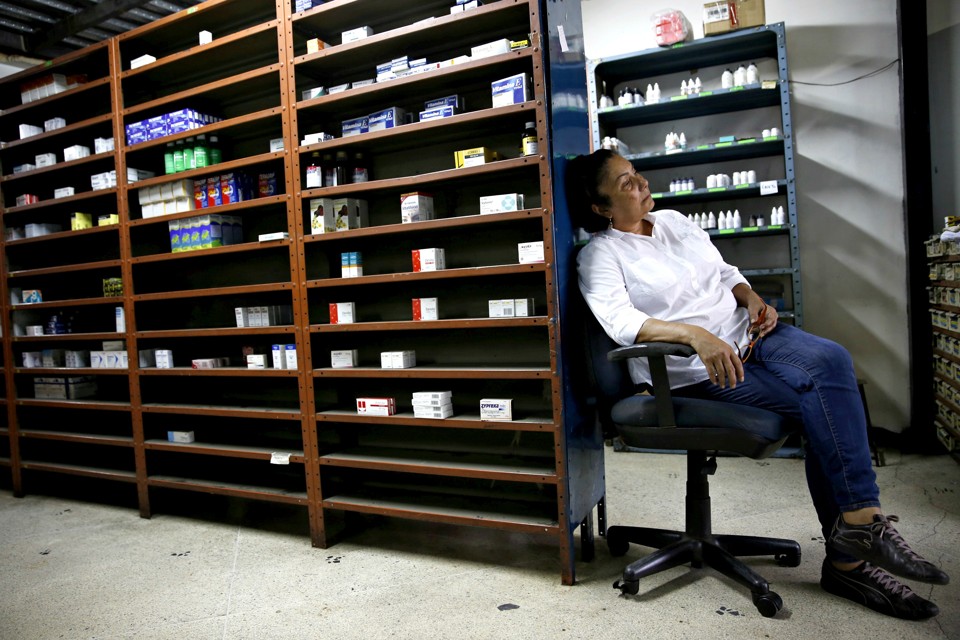
Finding the basic requirements of daily life has become the main preoccupation of Venezuelan families—and it can be a matter of life and death. At 14 years old, Maikel Mancilla Peña had been battling epilepsy for six years. His condition was under control, just about, thanks to a common anti-convulsive prescription drug called Lamotrigine. It had long been a struggle for his family to get it, but as the gap between the real cost of the drugs and the maximum pharmacies were allowed to charge for them grew, it became impossible to find them.
On February 11th this year, Maikel’s mom Yamaris gave him the last Lamotrigine tablet in their stash. None of Yamaris’s usual pharmacies had any anti-convulsants in stock. She worked social media— which in Venezuela these days is filled with desperate people trying to source scarce medicines—but no luck. She drove hours to track down a lead, but came up empty-handed.
A pharmacy employee waits for customers at a drugstore in Caracas. (Noel West / Reuters)
In the following days, Maikel experienced a series of increasingly violent epileptic seizures, as his family watched helplessly. On February 20th, he suffered respiratory failure and died.
While Venezuelans were dying for lack of simple, inexpensive pills, their radical socialist government was spending tens of millions a year to keep a native son, Pastor Maldonado, competing in the Formula 1 global auto-racing circuit. You could be forgiven for not having heard of Maldonado—a mediocre driver who managed to win a single race in five years in the sport. Still, Venezuela’s state-owned oil company, PDVSA, spent some $45 million each year to keep Maldonado racing under its logo. Why an oil company without a retail arm and with monopoly rights to Venezuelan oil needs to advertise in the first place was never clear.
Yet Maldonado, whose habit of crashing in race after race earned him the nickname “Crashtor,” was only forced out of the F1 circuit this year, when PDVSA, hit by the oil crash, failed to come up with the sponsorship money.
The breakdown of law and order is so severe that even children are being robbed. At Nuestra Señora del Carmen school in El Cortijo, a struggling neighborhood of Caracas, supplies for the school-lunch program have been stolen twice this year already: Thugs have broken into the school’s pantry late at night after fresh food is delivered. The second burglary meant the school couldn’t feed the kids for at least a week.
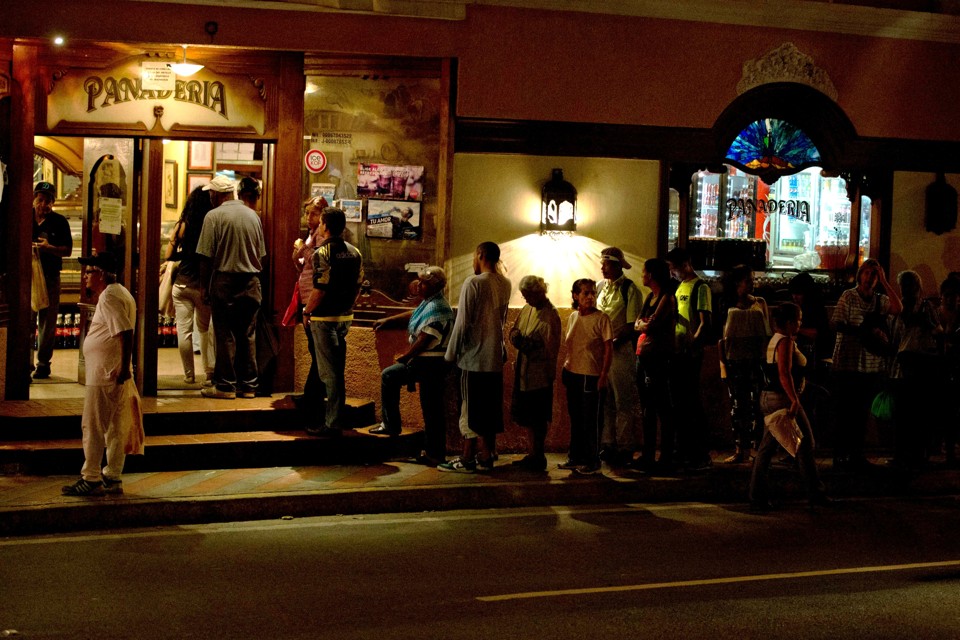
Resident of El Hatillo line up outside of a bakery to buy bread just outside of Caracas. (Fernando Llano / AP)
Elsewhere, school food programs have simply stopped working, because the government apparently can’t keep them supplied. In poorer communities, parents often respond to this by taking their kids out of school: They’re more useful standing in line outside a grocery store than sitting in a classroom. The regime has long put education at the center of its propaganda, yet the reality today is that a generation of underprivileged kids is being denied an education through straightforward hunger.
Still, some politicians seem to have found the bright side of their citizens’ hunger: The opposition-controlled National Assembly alleges that government officials or their cronies stole some $200 billion in food-import scams alone since 2003.
The Crime Outbreak Feeds the Zika Outbreak
In the midst of all this, Venezuela is facing one of the worst Zika outbreaks in South America, and it’s an epidemic the country can hardly measure, much less respond to. The Universidad Central de Venezuela’s Institute for Tropical Medicine is where the crime and public-health crises collide. The institute—ground zero in the country’s response to tropical epidemics—was burglarized a shocking 11 times in the first two months of 2016. The last two break-ins took place within 48 hours of one another, leaving the lab without a single microscope. Burglars rampaged through the lab, scattering samples of highly dangerous viruses and toxic fungal spores into the air.
Conditions like those make it virtually impossible for institute researchers to do their work, crippling the country’s response to the Zika outbreak. And attempts to repair the damage are undercut by the same dysfunctions that afflict the rest of the economy: There’s just no money to replace the expensive imported equipment criminals have stolen.
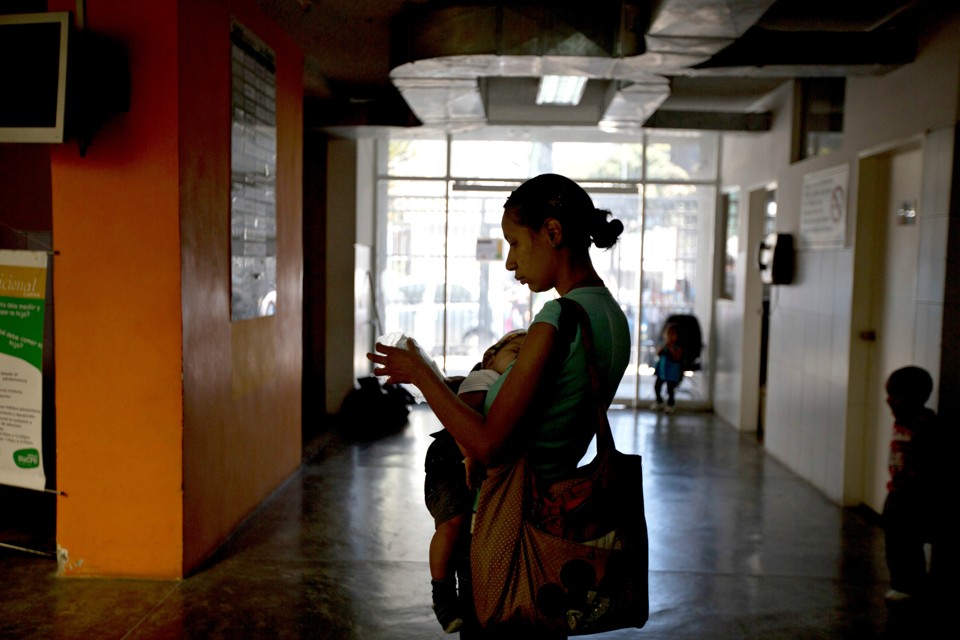
A woman holds her sick baby as she waits to see a doctor at a medical center near the Petare neighborhood in Caracas. (Fernando Llano / AP)
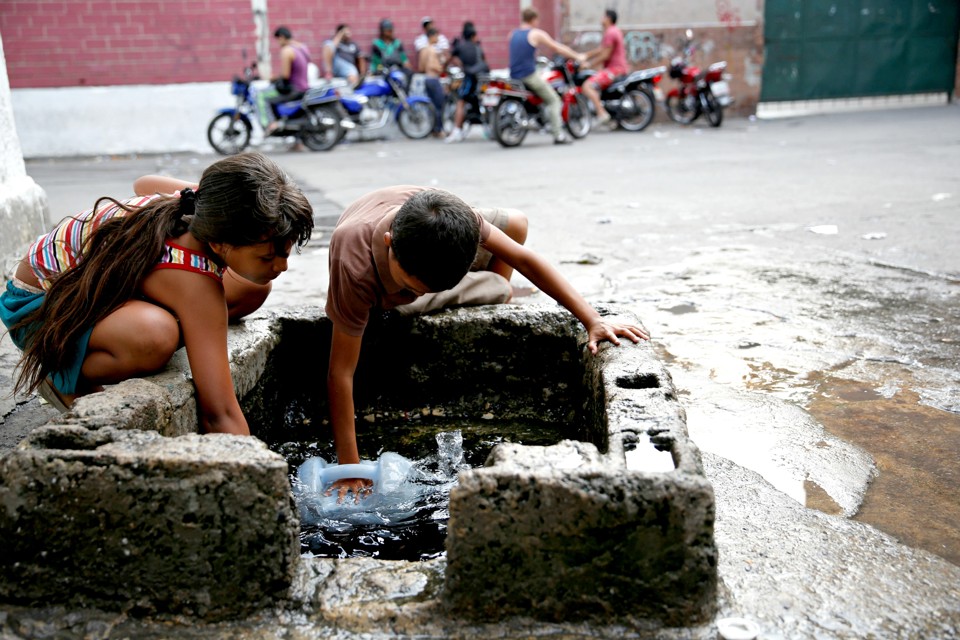
Other aspects of state collapse feed back on the Zika crisis as well. Venezuelan cities’ water infrastructure is crumbling after nearly two decades of neglect. That would be hard at the best of times, but this year’s El Niño has brought an acute drought to most of the country. Water utilities have responded to falling reservoir levels with harsh rationing measures.
Neighborhoods and shantytowns can go for days and even weeks with no piped water. Most people adapt by filling several buckets when service is provided, in preparation for the dry periods. Of course, storing water in buckets is precisely what you shouldn’t do when facing a mosquito-borne epidemic: The containers double as breeding grounds for the bugs that transmit the Zika virus, as well as others like Chikungunya, dengue, even malaria.
No Power, No Justice
The same drought that’s forcing water rationing has seen water levels at the country’s electricity-generating dams fall alarmingly. Blackouts used to at least spare the capital, but these days they’re nationwide, as the public utilities struggle to keep enough water in the reservoirs to prevent a complete collapse in the power grid.
Following Venezuela closely means hearing any number of stories like these. The happy, hopeful stage of Venezuela’s experiment with Chavez’s 21st-century socialism is a fading memory. What’s been left is a visibly failing state that still leans hard on left-wing rhetoric in a doomed bid to maintain some shred of legitimacy. A country that used to attract fellow travelers and admirers in serious numbers now holds fascination for rubberneckers: stunned outsiders enthralled by the spectacle of collapse.
To the Venezuelans who live its consequences day after day, the spectacle is considerably less amusing. Our toilet-paper-seeking industrialist found very little mirth in it. After being arrested on absurd charges of hoarding, he realized that it was just a shakedown: The cops were far less interested in his toilet paper than his money.
“Their opening bid was in the high hundreds of thousands of dollars,” he said. “I thought that was a bit much; we bargained.”
In the end, he said, the cops agreed to drop the criminal charges for a few tens of thousands of dollars.
That time, the regime’s appetite for theft trumped its instinct for repression. Next time, who can tell?
"The inherent vice of capitalism is the unequal sharing of blessings; the inherent virtue of socialism is the equal sharing of miseries." -- Winston Churchill
There are a lot of arguments about whether communism, socialism, and liberalism are the same thing. What shouldn't be arguable is that they're all closely related branches of the same tree. If you don't want to live in a house made out of Aleppo Pine, you probably won't like a Coulter Pine or Eastern White Pine house either. However, since socialism has failed so often, socialists of every stripe bend over backwards to disassociate themselves from the many other disasters created by their ideology. Still, a pine by any other name is still a pine.
Socialism is particularly dangerous because it's so perfectly suited for the modern era. It's the ultimate "miracle" product: it's "nice," it's "fair," it'll make you feel good about yourself, it'll "help" people who "deserve it" by taking things away from people who "have so much" they'll barely miss it. It sounds wonderful, doesn't it? But, like most products with sleazy salesmen and hidden track records, the promises socialism makes are all a mirage. Since our schools do a terrible job of teaching history and economics these days, it's our job to explain how socialism slowly, insidiously eats away at the core of a society.
1) It kills economic growth: Strong economic growth is what produces jobs, tax revenue and a better standard of living for everyone, including the poor and middle class. That's what John F. Kennedy was driving at when he said, "A rising tide (in the economy) lifts all boats." Socialism strangles economic growth in the crib by penalizing success and rewarding failure. When you loot the successful people in a society to give it to the less successful, you quite naturally reduce the number of successful people and encourage more people to fail. This leads to a never-ending cycle. The more people in need there are, the more the successful must be penalized to pay for them. The more the successful are penalized, the fewer successful people there are. This causes wealth to concentrate in fewer hands, the economy slows down, and even more people need help. It goes on and on until you get a slow economy that can't produce enough tax revenue to sustain itself. That's exactly what killed the Soviet Union, it's killing Greece right now and sadly, the United States and most of Western Europe is on exactly the same path.
2) It stifles free speech: Why is there ridiculous government propaganda in nations like North Korea? Why are most schools, papers, and colleges run by liberals in the United States? Why do liberals often try to disrupt conservative speakers on college campuses? Why are there such extreme speech codes in Canada that it practically makes some conservative arguments illegal? Why does speaking out against the government risk imprisonment in China and the old Soviet Union? Because socialism requires protection, propaganda, intimidation, and darkness to survive. Socialism can't survive honest, informed debate about its merits among people who are free to choose or reject it because it would not survive the conversation. As Reagan said, "How do you tell a communist? Well, it's someone who reads Marx and Lenin. And how do you tell an anti-Communist? It's someone who understands Marx and Lenin."
3) It leads to an increasingly tyrannical government: Freedom and socialism go together like oil and water. The more socialism you have, the less freedom you will have because socialism can't survive if people are free to choose whether they want socialism or not. People who are free to say what they want will criticize socialism's many failures. Areas that aren't tightly controlled will move towards the free exchange of ideas and goods, not socialism. So, socialism requires a massive bureaucracy that almost inevitably grows. As government grows, it inevitably becomes more centralized, more distant from the people and ultimately more menacing.
4) It creates strife and division: Socialism is all about turning people against each other. It has to be. After all, if you believe in controlling people's lives, the people who don't wish to be controlled need to be vilified. If you believe in confiscating the wealth of successful people who won't give it up willingly, then others must be convinced they're terrible human beings who deserve to be punished. "Victim" classes must be created for the socialists to defend because if everyone is responsible for himself, what need is there for the socialist? Eventually, those who depend on government for their livelihood and those that the government smears and loots to pay them off come to hate each other.
5) Socialists believe the ends justify the means: Like the pigs in Orwell's Animal Farm, socialists believe that, "All animals are equal, but some animals are more equal than others." For a socialist, the overriding concern is always promoting socialism; so process, rules and regulation mean different things for different people. Fidel Castro may have been the leader of a Communist revolution against the evil "rich people" in Cuba, but he’s worth 900 million dollars today. A law broken by a Democrat and a Republican may be treated very differently by the papers, the courts, and even the Department of Justice under Eric Holder. As Margaret Thatcher explained,
"Left-wing zealots have often been prepared to ride roughshod over due process and basic considerations of fairness when they think they can get away with it. For them the ends always seems to justify the means. That is precisely how their predecessors came to create the gulag."
One of the reasons so many socialist nations are wracked with violent protests and revolutions is because when the rule of law is abandoned, only outlaws have any hope of receiving justice.
Remember this term: P20W, because it is cloaked in intrusion and manipulation. The "core" of this concept is birth to death control by government. From uterus to workforce, Common Core's "Big Brother" concept tracks your every move. While we watch the federal government take over our healthcare our and education, what will be the next intrusion into the lives of free men and women of America? Is this what liberty looks like or are we staring down the barrel of a socialistic dictatorship?
This is taking place in Oregon now, but you can be assured, it is already in or soon coming to a State near you. Be alert!